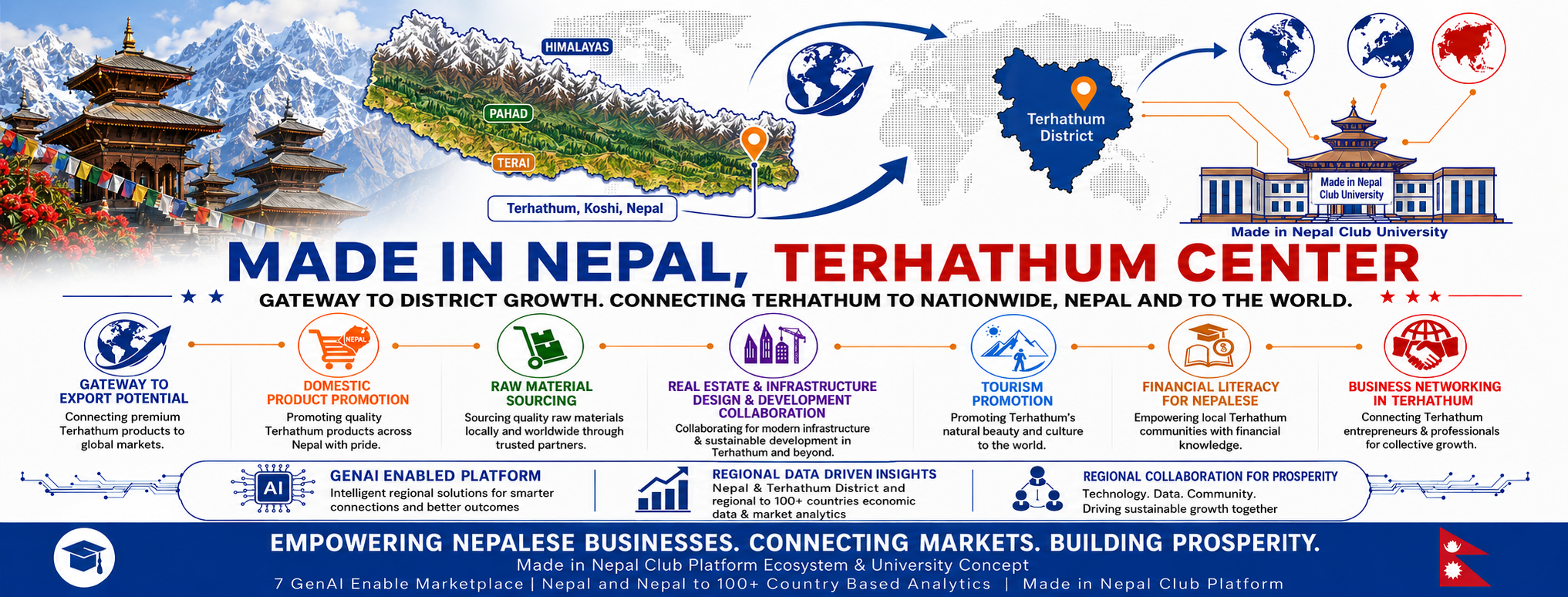
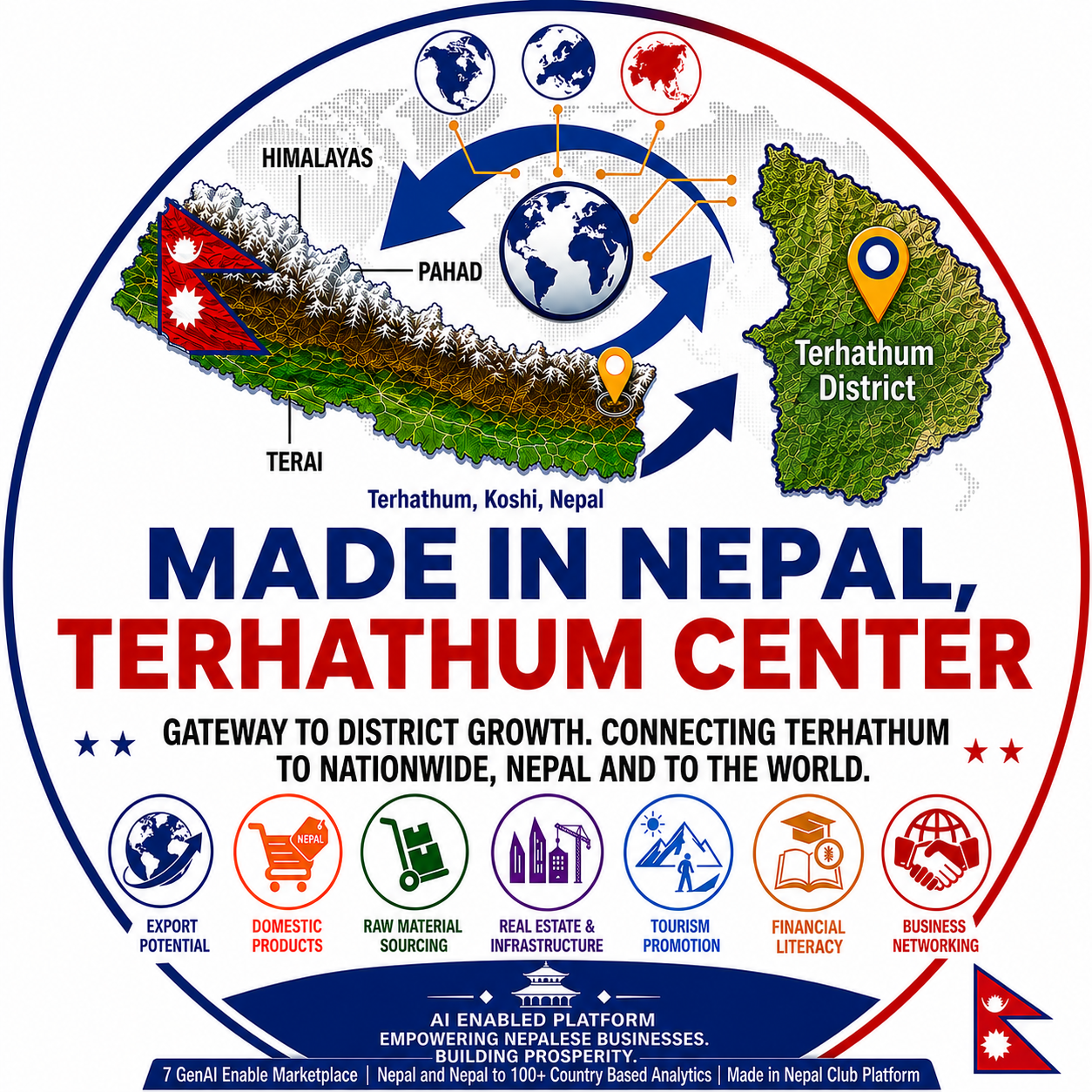
Gateway to Growth. Connecting Terhathum to Nepal and the World.
VisitTerhathum.com | International + Nepal Business Strategy Brief
Terhathum Economic Gateway
From High-Value Hill Agriculture & Rhododendron Tourism
to Nationwide Scale and Global Connectivity.
Strategic Research BriefSeptember 2026Terhathum District, Koshi Province, Nepal
Gateway to Export Potential •
Domestic Product Promotion •
Raw Material Sourcing •
Real Estate & Infrastructure Design & Development Collaboration •
Tourism Promotion •
Financial Literacy for Nepalese •
Business Networking in Terhathum, Nepal and to the World
One District. Three Markets.
A Rhododendron & Hill-Enterprise Gateway.
Terhathum had 88,731 residents
in Nepal's 2021 census and has
six local governments —
two municipalities and four rural municipalities.
The National Economic Census 2018 recorded
3,412 establishments engaging 8,955 people.
The district combines high-value hill agriculture,
tea/coffee, Basantapur–Tinjure tourism,
Hyatrung waterfall, Limbu/Yakthung culture
and Mid-Hill Highway connectivity.
Economic architecture:
TERHATHUM DISTRICT →
NATIONWIDE NEPAL →
GLOBAL BUYERS, VISITORS,
INVESTORS, DIASPORA & TECHNOLOGY.
88,731Population · 2021
3,412Establishments · 2018
53,577.57 MTPotato production
5,772Residents abroad · 2021
Seven Integrated Global Platforms
Benefit Terhathum businesses locally,
Nepal nationally and markets globally
Every feasibility study should test
district commercial impact,
Nepal-wide scalability
and global buyer, visitor, investor,
technology and diaspora relevance.
Current Koshi Province data list
53,577.57 MT potato,
284.90 MT large cardamom,
3,761.42 MT mandarin
and 2,531.63 MT lime.
Build export readiness around grading,
improved drying, food safety,
packaging, traceability,
phytosanitary compliance,
HS classification,
freight economics
and verified buyer demand.
Tea, coffee and local foods
should be screened as premium niches.
Three-market beneficiaries:
District farmers/cooperatives/processors;
Nepal wholesalers, hospitality and exporters;
global spice/citrus buyers,
specialty retailers and diaspora.
Market Research and Feasibility Study On:
Gateway to Export Potential
View Market Research→
2
Domestic Product Promotion
Build a recognizable
Made in Terhathum
identity around rhododendron-country origin,
Limbu/Yakthung heritage,
cardamom, citrus, tea/coffee
and hill foods.
Use verified producer directories,
packaging standards,
QR-origin stories,
Myanglung–Basantapur showcases,
Koshi trade events,
hospitality procurement
and Nepal-wide e-commerce
before larger international promotion.
Three-market beneficiaries:
District producers/retailers;
Nepal distribution, hospitality and e-commerce;
global diaspora, visitors
and specialty markets.
Market Research and Feasibility Study On:
Domestic Product Promotion
View Market Research→
3
Raw Material & Technology Sourcing
Priorities include efficient cardamom dryers,
tea processing/packaging,
citrus post-harvest systems,
cold storage, irrigation,
food processing, solar energy,
water technology
and digital commerce/logistics.
Use a
Nepal-first → regional → global
hierarchy based on productivity,
lifecycle cost, maintainability,
training and spare-parts access.
Three-market beneficiaries:
District productivity and lower loss;
Nepal suppliers/labs/technical institutions;
global OEM, certification
and technology partners.
Market Research and Feasibility Study On:
Raw Material & Technology Sourcing
View Market Research→
4
Real Estate & Infrastructure
Design & Development Collaboration
Focus on agro-collection/cold-chain hubs,
market sheds, warehouses,
tourism lodges/homestays,
broadband, water/waste systems
and resilient road/logistics nodes.
The Department of Roads
Terhathum network page lists
125.07 km
of national-highway links,
including Myanglung–Basantapur.
Road condition, seasonal reliability,
operator demand and financing
should be tested before investment.
Three-market beneficiaries:
District municipalities/farmers/tourism SMEs;
Nepal developers, engineers, banks and operators;
global diaspora
and technical/investment partners.
Market Research and Feasibility Study On:
Real Estate & Infrastructure
Design & Development Collaboration
View Market Research→
5
Tourism Promotion — Visit Terhathum
Nepal Tourism Board positions
Basantapur (2,200 m)
and Tinjure (3,066 m)
as rhododendron, sunrise/sunset
and Limbu-culture destinations
and identifies the
Tinjure–Milke–Jaljale Rhododendron Trail
across Terhathum,
Taplejung and Sankhuwasabha.
Add Hyatrung waterfall,
Cholung cultural park,
Myanglung and village stays
to create bookable multi-day circuits.
Three-market beneficiaries:
District hotels/homestays/guides/retail;
Nepal tour operators and eastern circuits;
global nature/culture travelers,
diaspora and specialist visitors.
Market Research and Feasibility Study On:
Tourism Promotion — Visit Terhathum
View Market Research→
6
Financial Literacy for Nepalese
Serve farmers,
tea/cardamom cooperatives,
tourism SMEs, youth,
migrant households and returnees
with bookkeeping,
seasonal cash-flow,
productive credit,
insurance, digital payments,
tax awareness,
foreign-exchange literacy,
remittance planning
and responsible-investing education.
The 2021 census recorded
5,772 Terhathum residents abroad.
Three-market beneficiaries:
District resilient households/SMEs;
Nepal formal finance and entrepreneurship;
global remittance,
diaspora capital
and returnee-business links.
Market Research and Feasibility Study On:
Financial Literacy for Nepalese
View Market Research→
7
Business Networking in Terhathum,
Nepal and to the World
Use the district's
3,412 recorded establishments
as the starting base
for a verified B2B directory.
Connect farmers,
tea processors,
cardamom traders,
tourism businesses,
contractors and professionals
with Nepal-wide buyers,
exporters, banks and institutions,
then extend globally to diaspora,
importers, tour operators,
mentors, investors
and technology providers.
Three-market beneficiaries:
District trusted discovery/referrals;
Nepal buyers, finance and institutional access;
global diaspora, importers,
investors, mentors
and technology partners.
Market Research and Feasibility Study On:
Business Networking in Terhathum,
Nepal and to the World
View Market Research→
High-value agriculture:
current Koshi data list
53,577.57 MT potato,
284.90 MT large cardamom,
3,761.42 MT mandarin
and 2,531.63 MT lime.
Terhathum's tea survey counted
317 tea farmers/estates;
coffee data for FY 2022/23 record
92 farmers, 40.9 ha
and 3 MT production.
Tourism:
NTB highlights Basantapur,
Tinjure and the TMJ Rhododendron Trail.
Koshi Tourism Year 2082
was inaugurated
in the Tinjure region in April 2025,
reinforcing the area's
provincial destination role.
Hyatrung and Limbu cultural assets
can extend stays
and local spending.
Connectivity:
DOR's Terhathum road-network page
lists 125.07 km
of national-highway links.
Feasibility should focus
on all-season logistics,
last-mile access,
visitor safety
and cold-chain economics
rather than road length alone.
Diaspora:
5,772 residents abroad
can become buyers,
mentors, investors
and tourism ambassadors
when opportunities
are verified and transparent.
International + Nepal Business Strategy
VisitTerhathum.com should operate
as Terhathum's integrated
economic gateway rather than
as a tourism-only portal.
The seven platforms should connect
production, processing,
local commerce,
nationwide distribution,
destination development,
infrastructure,
financial capability
and global networks
under one market-development architecture.
LOCAL VALUE CREATION +
NATIONWIDE DISTRIBUTION +
GLOBAL MARKET ACCESS +
CARDAMOM / CITRUS / TEA +
RHODODENDRON TOURISM +
CONNECTIVITY +
DIASPORA CAPITAL +
B2B NETWORKS
Initial Execution Priorities
Build a verified producer/business directory;
map cardamom drying
and citrus/potato post-harvest gaps;
strengthen tea/coffee branding;
package Basantapur–Tinjure–Hyatrung
cultural/nature circuits;
assess cold-chain
and road-logistics bottlenecks;
improve homestay/service standards;
and activate diaspora buyers,
mentors and screened investors.
Turning Terhathum's Hill Identity
Into Measurable Economic Opportunity
VisitTerhathum.com /
Made in Nepal, Terhathum Center
can connect farmers,
processors,
tourism communities,
professionals and entrepreneurs
with Nepal's domestic economy
and with global buyers,
visitors, investors,
diaspora and technology partners.
Currency Standard:
All financial figures
on this platform
should be displayed in
Nrs and USD.
Nepal Rastra Bank's
7 September 2026 rate was
USD 1 =
Nrs 150.88 buying /
Nrs 151.48 selling.
For indicative conversions
this research uses
the midpoint of approximately
Nrs 151.18 = USD 1.
Actual banking
and transaction rates may differ.
Research & Information Disclaimer:
This page is intended
for general district economic-development,
business, trade, tourism,
infrastructure and
financial-education information.
It does not constitute
legal, tax, engineering,
customs, regulated financial
or investment advice.
Product markets,
technology purchases,
road/logistics assumptions,
tourism concepts,
land/infrastructure projects
and investments should undergo
current technical,
regulatory,
environmental,
market and financial
feasibility review.
Research Published by
Jay Sarraf, USA, Currently in Kathmandu, Nepal
,
Supported by
The Raj Sarraf, USA